
Discover how biogas and Compressed Bio-Gas (CBG) are produced from organic feedstock through anaerobic digestion. Learn about the biological process, gas purification, CBG production, applications, and the role of waste-to-energy technology in India’s renewable energy transition.
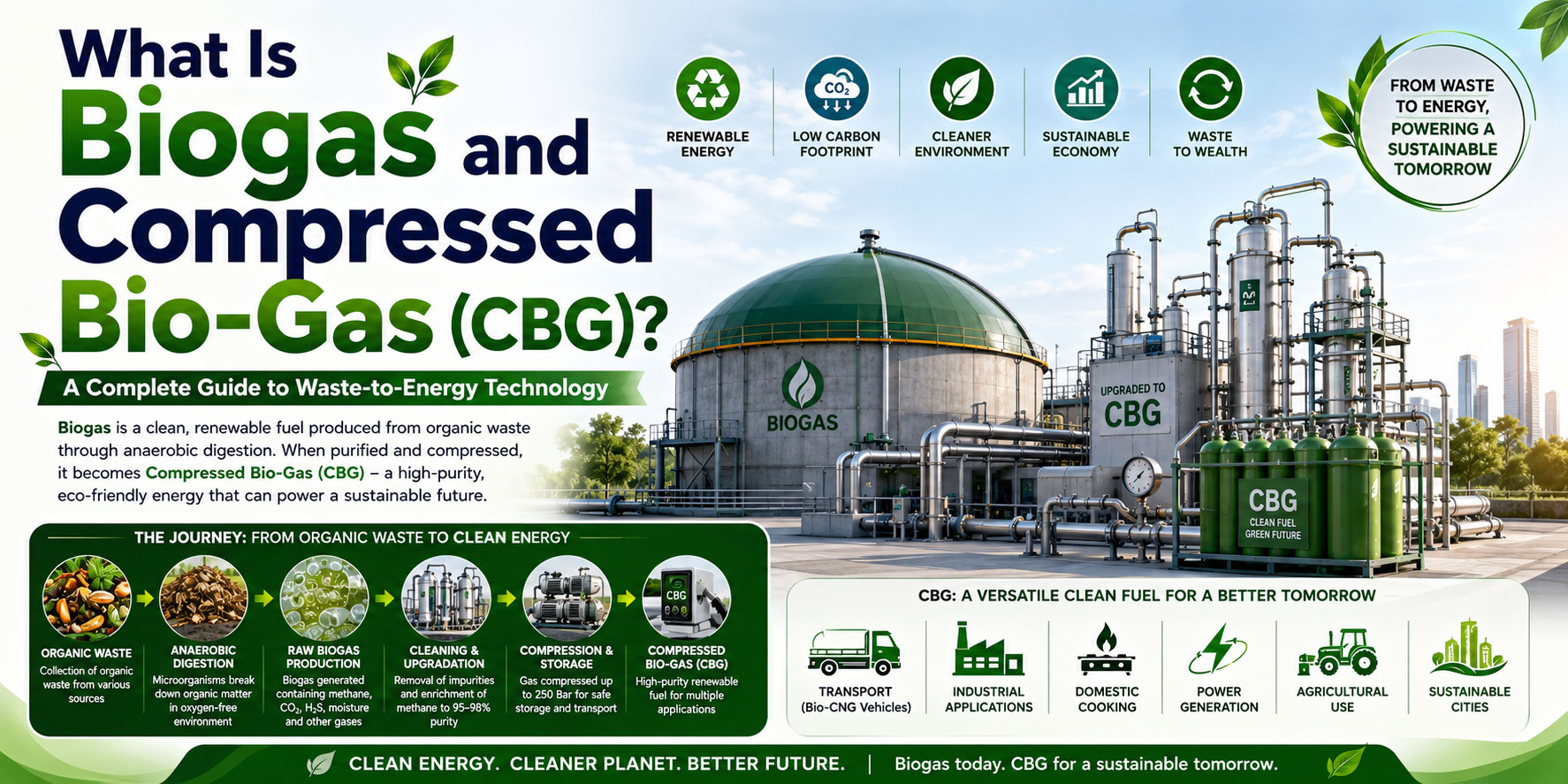
The transition toward cleaner and more sustainable sources of energy is creating new opportunities to transform organic waste into valuable resources. Among the technologies contributing to this transition, biogas and Compressed Bio-Gas (CBG) have emerged as important solutions for renewable energy production, scientific organic waste management, and resource recovery.
India generates substantial quantities of biodegradable organic materials from agriculture, livestock, food processing industries, municipalities, and other commercial and industrial activities. Cattle dung, agricultural residues, food waste, press mud, energy crops, sewage sludge, and various organic industrial by-products contain biodegradable matter that can potentially be converted into useful energy through properly designed biological processes. At the centre of this conversion is anaerobic digestion, a controlled biological process in which microorganisms break down biodegradable organic matter in the absence of oxygen. The process produces two principal outputs: biogas and digestate.
Raw biogas primarily contains methane and carbon dioxide, along with moisture, hydrogen sulfide, and other trace components depending on the feedstock and operating conditions. Through appropriate gas cleaning and upgrading technologies, unwanted components can be reduced and the methane concentration increased. The upgraded gas can then be compressed to produce Compressed Bio-Gas (CBG) for suitable commercial and energy applications. However, a modern CBG plant is far more than a combination of a digester, purification system, and gas compressor.
Successful CBG production requires the integration of feedstock science, microbiology, biochemical processes, digester engineering, gas purification, mechanical systems, instrumentation and automation, process control, safety systems, digestate management, and efficient plant operation.
The performance of each system is interconnected. A problem in feedstock preparation can affect digester biology. Biological instability can reduce raw biogas production. Changes in gas composition can influence purification system performance. Poor process control can ultimately affect the quantity, quality, and consistency of CBG production.
For this reason, understanding the fundamental difference between biogas production and CBG production is essential for anyone planning, designing, investing in, operating, or evaluating a biogas or CBG project.
In Day 1 of the Sonali Bio Gas Daily Knowledge Series, we begin with the foundation of the industry: what biogas is, how it is produced, how raw biogas is upgraded into CBG, and why an integrated understanding of biology and engineering is critical for successful plant performance.
Biogas is produced through a biological process. CBG is produced by integrating that biological process with gas treatment, purification, compression, engineering, and process control.
Biogas is a renewable gaseous fuel produced through the biological decomposition of biodegradable organic matter under oxygen-free conditions. This controlled process is known as anaerobic digestion.
Unlike fossil fuels, which are extracted from finite geological reserves, biogas is produced from renewable organic resources such as animal manure, agricultural biomass, food waste, agro-industrial residues, sewage sludge, and other biodegradable materials.
At the heart of biogas production is a diverse microbial community.
Inside an anaerobic digester, different groups of microorganisms work together in a complex biological ecosystem. These microorganisms progressively break down organic matter and convert a portion of its biodegradable fraction into methane-rich biogas.
The overall process can be represented as:
Organic Feedstock → Anaerobic Digestion → Biogas + Digestate
The two principal outputs of the anaerobic digestion process are:
Although biogas is often described in simple terms as gas produced from organic waste, the actual process is significantly more complex.
Biogas production is the result of a carefully balanced biological system involving multiple microbial communities, biochemical reactions, and operational parameters.
The performance of an anaerobic digester depends on several interconnected factors, including:
A disturbance in any one of these parameters can influence microbial activity and, consequently, affect the quantity, composition, and consistency of biogas production.
For example, excessive organic loading can result in the production of Volatile Fatty Acids faster than methanogenic microorganisms can consume them. Similarly, sudden temperature fluctuations, ammonia inhibition, inadequate mixing, or poor feedstock management can disturb the biological balance of the digester.
This is why a successful biogas plant should be understood as a controlled biological process system, not merely as a tank into which organic material is fed.
Raw biogas is a mixture of gases, and its exact composition varies according to the feedstock, digestion technology, operating conditions, and biological stability of the process.
The major components generally include:
The composition of raw biogas is important because it directly influences its energy value, treatment requirements, purification technology selection, equipment design, corrosion management, and final utilization.
The fundamental concept behind biogas production can be summarized as:
Biodegradable Organic Matter → Microbial Conversion → Methane-Rich Biogas → Renewable Energy
However, not all organic matter fed into a digester is converted into biogas. Only the biodegradable fraction of the feedstock is available for microbial conversion, and the extent of degradation depends on factors such as feedstock characteristics, pretreatment, digester design, retention time, temperature, loading conditions, and microbial activity.
This distinction is particularly important in commercial biogas and CBG projects because plant capacity should not be estimated solely on the basis of the total quantity of feedstock available.
A technically sound project requires a proper understanding of the quality, composition, biodegradability, and potential methane yield of the feedstock.
A biogas plant does not produce gas simply because organic material is fed into a digester. It produces biogas when the feedstock characteristics, microbial ecosystem, digester design, and operating conditions work together as a balanced biological process.
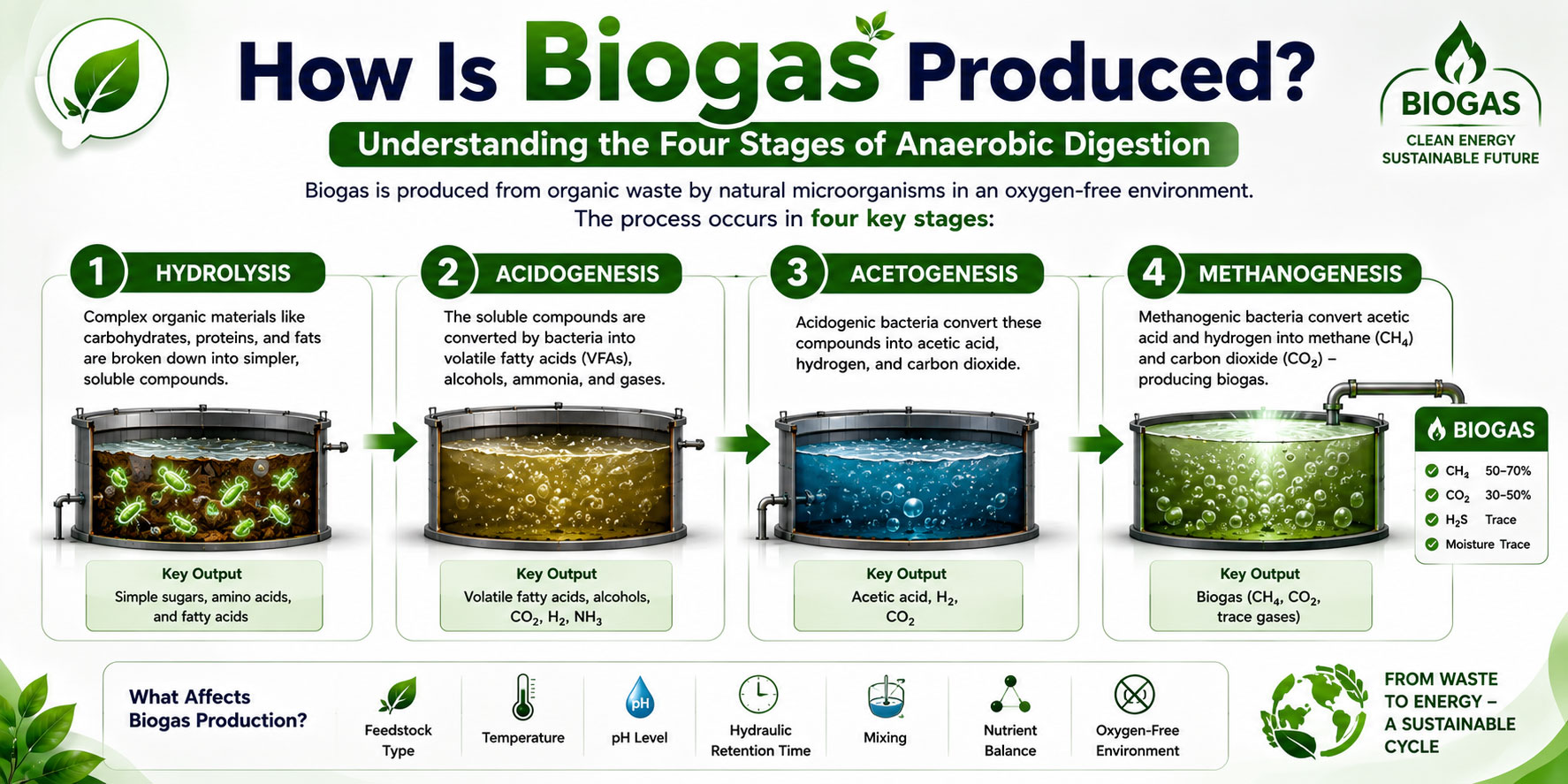
Biogas production is the result of a complex series of biological and biochemical reactions that take place inside an anaerobic digester.
The process does not occur through the activity of a single type of microorganism. Instead, different microbial communities work together in a coordinated biological system, with each group performing a specific function in the conversion of complex organic matter into methane-rich biogas.
The anaerobic digestion process is generally described in four principal stages:
Hydrolysis → Acidogenesis → Acetogenesis → Methanogenesis
Although these stages are explained separately for technical understanding, in a conventional single-stage anaerobic digester they occur simultaneously and interact continuously. The stability and performance of the entire digestion process depend on maintaining an appropriate balance between these microbial groups.
Hydrolysis is the first major stage of anaerobic digestion.
Many organic feedstocks contain complex compounds that are too large to be directly utilized by the microorganisms involved in the subsequent stages of digestion.
These complex organic materials include:
During hydrolysis, microorganisms produce extracellular enzymes that break these complex compounds into smaller, soluble molecules.
The process can be simplified as:
Complex Organic Matter → Soluble Organic Compounds
For example:
These smaller compounds can then be utilized by microorganisms involved in the next stage of anaerobic digestion.
Hydrolysis can significantly influence the overall digestion rate, particularly when processing feedstocks containing slowly degradable or lignocellulosic materials.
Feedstocks such as agricultural residues and energy crops may contain complex structural components, including cellulose, hemicellulose, and lignin. While cellulose and hemicellulose can be biologically degraded under suitable conditions, lignin is highly resistant to anaerobic degradation.
Therefore, feedstock preparation and pretreatment can play an important role in improving the accessibility of biodegradable organic matter. Depending on the feedstock and project requirements, pretreatment may include:
The objective is not simply to reduce particle size, but to improve the accessibility of biodegradable material to microbial and enzymatic activity where technically and economically justified.
If complex organic matter is not effectively hydrolyzed, the subsequent microbial stages cannot efficiently convert it into methane.
After hydrolysis, the soluble compounds are further metabolized by acidogenic microorganisms.
This stage is known as acidogenesis.
During acidogenesis, simple organic compounds such as sugars and amino acids are converted into a range of intermediate products. These may include:
Common Volatile Fatty Acids produced during anaerobic digestion include:
The simplified process can be represented as:
Soluble Organic Compounds → VFAs + Alcohols + H2 + CO2 + Other Intermediates
Acidogenic microorganisms generally grow faster and can respond more rapidly to changes in feedstock loading than methane-producing microorganisms. This difference in microbial growth rates is extremely important for digester stability.
When excessive quantities of readily biodegradable organic matter enter the digester, acid-forming microorganisms may produce VFAs faster than downstream microbial communities can convert them.
This can result in:
Excessive Feeding → Rapid Acid Production → VFA Accumulation → Increased Biological Stress → Risk of Process Instability
However, VFA production itself is not a problem.
VFAs are essential intermediate compounds in the anaerobic digestion process.
The problem develops when the rate of VFA production becomes greater than the biological system’s capacity to consume and convert them.
VFAs are not undesirable by-products. They are essential intermediates. Process instability develops when VFA production and consumption become unbalanced.
During acetogenesis, microorganisms further convert several intermediate products formed during acidogenesis into compounds that can be utilized through methane-producing pathways. Important products of this stage include:
The simplified process can be represented as:
Higher VFAs and Other Intermediates → Acetate + H2 + CO2
Acetogenesis is particularly important because several compounds produced during acidogenesis cannot be directly utilized by methanogens. They must first be converted into suitable substrates.
One of the most technically interesting aspects of anaerobic digestion is the relationship between acetogenic microorganisms and hydrogen-consuming methanogens.
Certain acetogenic reactions are only energetically favourable when hydrogen concentrations remain sufficiently low. Hydrogen-consuming methanogens help maintain these conditions by continuously utilizing hydrogen. This creates a mutually dependent biological relationship known as syntrophy.
In simple terms:
Acetogens Produce Hydrogen → Methanogens Consume Hydrogen → Low Hydrogen Conditions Support Further Acetogenic Conversion
This demonstrates why anaerobic digestion should be understood as an interconnected microbial ecosystem rather than a sequence of isolated reactions.
The performance of one microbial group directly influences the conditions required by another. Anaerobic digestion depends on biological cooperation between microbial communities.
Methanogenesis is the final methane-forming stage of anaerobic digestion. During this stage, specialized microorganisms known as methanogenic archaea convert suitable substrates into methane.
Two important methane-forming pathways are:
Simplified representation:
Hydrogen + Carbon Dioxide → Methane + Water
These methane-producing microorganisms are critical to the entire anaerobic digestion process. However, methanogens are generally more sensitive to environmental and operational disturbances than many acid-forming microorganisms. Their activity can be affected by:
When methanogenic activity declines, the upstream microbial stages may continue producing intermediate compounds. This can create a biological imbalance.
The simplified chain is:
Methanogenic Stress → Reduced Intermediate Consumption → VFA Accumulation → Increasing Process Imbalance → Reduced Methane Production
This is one of the fundamental reasons why maintaining a stable microbial ecosystem is essential for reliable biogas production.
The complete anaerobic digestion pathway can be summarized as:
Complex Organic Matter
↓
HYDROLYSIS
Sugars + Amino Acids + Fatty Acids
↓
ACIDOGENESIS
VFAs + Alcohols + Hydrogen + Carbon Dioxide
↓
ACETOGENESIS
Acetate + Hydrogen + Carbon Dioxide
↓
METHANOGENESIS
Methane-Rich Biogas
The important point is that the performance of each stage influences the next. A successful anaerobic digester requires a balance between:
If one stage operates significantly faster or slower than the others, intermediate compounds can accumulate and biological stability may deteriorate.
One of the most common misconceptions about biogas plants is that increasing the quantity of feedstock will automatically increase gas production.
In reality:
More Feedstock ≠ Automatically More Biogas
Every anaerobic digester has a biological processing capacity. When organic material is supplied at a rate that exceeds the ability of the microbial ecosystem to process it, the digester can become overloaded. This may result in:
Therefore, successful biogas production requires the correct balance between:
Feedstock Characteristics + OLR + HRT + Temperature + pH + VFA & Alkalinity + Microbial Activity
Anaerobic digestion is not simply the decomposition of organic waste. It is a coordinated biological process in which multiple microbial communities must remain in balance to achieve stable and efficient methane production.
Understanding these four biological stages provides the foundation for designing, operating, and troubleshooting modern biogas and CBG plants.
Raw biogas produced inside an anaerobic digester is not pure methane. It is a mixture of gases whose composition depends on the type of feedstock, biological process conditions, digester configuration, operating temperature, Organic Loading Rate (OLR), Hydraulic Retention Time (HRT), and overall process stability.
Understanding raw biogas composition is essential because gas quality directly influences:
A biogas plant should therefore not be evaluated only on the basis of how many cubic metres of gas it produces. Two plants producing the same volume of raw biogas may have significantly different methane output and energy potential.
The composition of raw biogas varies according to the feedstock and digestion process. A typical raw biogas stream may contain:
| Component | Typical Range | Significance |
|---|---|---|
| Methane (CH4) | Approximately 50-70% | Primary energy-bearing component |
| Carbon Dioxide (CO2) | Approximately 30-50% | Reduces the calorific value of raw biogas |
| Hydrogen Sulfide (H2S) | Variable | Toxic, corrosive, and undesirable |
| Water Vapour | Usually saturated | Can cause condensation and operational problems |
| Nitrogen (N2) | Trace to variable | Can reduce final gas quality |
| Oxygen (O2) | Trace to variable | Requires monitoring for process and safety reasons |
| Ammonia (NH3) | Trace quantities | May affect equipment and downstream treatment |
| Other Trace Compounds | Feedstock-dependent | May require specific treatment strategies |
These values should be treated as general ranges rather than universal design specifications. Actual gas composition should be determined through proper gas analysis.
Methane is the most valuable component of biogas from an energy perspective. It is the combustible fraction responsible for most of the usable energy content of the gas.
In general:
Higher Methane Concentration → Higher Energy Content per Unit Volume of Gas
However, methane concentration alone does not provide a complete assessment of plant performance. For example, consider two hypothetical plants:
Plant A
Raw Biogas Production: 10,000 Nm³/day
Methane Concentration: 50%
Approximate Methane Volume:
5,000 Nm³ CH4/day
Plant B
Raw Biogas Production: 8,000 Nm³/day
Methane Concentration: 65%
Approximate Methane Volume:
5,200 Nm³ CH4/day
Plant A produces a larger total volume of raw biogas.
However, Plant B produces a greater calculated volume of methane.
This demonstrates an important principle:
Raw Biogas Volume ≠ Actual Methane Production
Therefore, plant performance should be evaluated by monitoring both: Total biogas production and Methane concentration. Where appropriate, methane yield relative to feedstock or Volatile Solids input can provide an even more meaningful performance indicator.
Carbon dioxide is generally the second-largest component of raw biogas. Unlike methane, CO2 does not contribute to the useful calorific value of the gas. A higher concentration of carbon dioxide means that a greater portion of the raw gas volume is non-combustible.
For CBG production, a significant portion of the CO2 must be separated during the gas upgrading process to increase the methane concentration of the product gas. The simplified process can be represented as:
Raw Biogas → CO2 Separation → Methane Enrichment → Upgraded Biogas
The amount of CO2 present in the raw gas directly influences:
Therefore, purification technology should be selected based on actual gas composition and project requirements rather than simply on total raw biogas flow.
Hydrogen sulfide is one of the most important undesirable components found in raw biogas. It is formed primarily from the biological degradation of sulfur-containing compounds present in the feedstock.
H2S is particularly important because it is: Toxic, Corrosive, Harmful to equipment, and Undesirable in the final product gas.
In the presence of moisture, hydrogen sulfide can contribute to highly corrosive conditions. This may affect: Gas pipelines, Compressors, Heat exchangers, Storage systems, Valves, Instrumentation, and Engines and other gas utilization equipment.
The concentration of H2S can vary substantially depending on the feedstock. For example, feedstocks containing higher quantities of sulfur-containing proteins or compounds may generate raw biogas with higher H2S concentrations.
This is why H2S removal systems should be designed according to actual gas characteristics. Treatment methods may include: Biological desulfurization, Iron-based media, Activated carbon, Chemical treatment, and Other suitable gas-cleaning technologies.
The appropriate method depends on factors such as: Inlet H2S concentration, Required outlet specification, Gas flow rate, Operating cost, Media replacement requirements, and Process configuration.
Raw biogas leaving an anaerobic digester typically contains a significant amount of water vapour. As the gas cools while moving through pipelines and downstream equipment, moisture can condense.
This can create several operational problems, including: Water accumulation in gas pipelines, Increased corrosion risk, Pressure losses, Damage to downstream equipment, Interference with gas treatment systems, and Reduced reliability of instruments.
Therefore, moisture management is an essential part of biogas treatment. Depending on the plant configuration, moisture reduction may involve: Gas cooling, Condensate traps, Moisture separators, Chillers, Drying systems, and Proper gas pipeline design.
An effective gas treatment system should not treat moisture removal as an afterthought. It should be integrated into the overall process design.
Nitrogen and oxygen may also be present in raw biogas in varying concentrations. Their presence can result from: Air ingress, Feedstock handling, Biological desulfurization systems using controlled air dosing, Leakage, and Process conditions.
Excessive air ingress should be carefully controlled. Apart from reducing product gas quality, oxygen entering methane-containing gas systems requires careful attention from a process safety perspective. Proper plant design should include: Gas-tight construction, Suitable instrumentation, Gas detection systems, Controlled operating procedures, and Appropriate safety systems.
Depending on the feedstock source, raw biogas may contain other trace compounds. These can include: Ammonia, Volatile Organic Compounds (VOCs), Siloxanes, Sulfur compounds, and Other feedstock-specific contaminants.
Siloxanes, for example, may be particularly relevant in biogas produced from sewage sludge, landfill gas, or certain industrial and consumer-product-related waste streams. When combusted, siloxanes can form abrasive deposits that may damage engines and other equipment.
This demonstrates why gas treatment requirements cannot be standardized solely according to plant capacity.
Different Feedstocks → Different Gas Composition → Different Treatment Requirements
The objective of a CBG purification system is not simply to “clean the gas.” The system must process a variable raw gas stream and consistently produce gas meeting the required product specifications.
To achieve this, engineers must understand: Raw biogas flow rate, Methane concentration, Carbon dioxide concentration, H2S concentration, Moisture content, Oxygen concentration, Nitrogen concentration, Trace contaminants, and Expected gas composition fluctuations.
These parameters influence the selection and sizing of: H2S removal systems, Moisture removal systems, Gas purification technology, Gas compressors, Buffer vessels, Instrumentation, and Safety systems.
Consider two hypothetical CBG plants.
Plant A
Raw Gas Flow: 1,000 Nm³/hour
Methane: 55%
CO2: 43%
High H2S concentration
Plant B
Raw Gas Flow: 1,000 Nm³/hour
Methane: 65%
CO2: 33%
Low H2S concentration
Although both plants process the same volume of raw biogas, their treatment requirements are not identical. Plant A may require: Greater CO2 removal duty, Higher H2S treatment capacity, Different operating conditions, Different energy consumption, and Potentially different methane recovery considerations.
This is why purification systems should be engineered according to gas composition, required product specification, methane recovery targets, operating profile, and project-specific conditions.
One of the most important principles in commercial biogas projects is understanding the difference between gas quantity and gas quality.
Gas Quantity:
How much total raw biogas is being produced?
Gas Quality:
What is the composition of that gas?
A technically meaningful evaluation should consider:
Raw Biogas Flow + Methane Percentage + Methane Yield + Contaminant Levels + Process Stability
Monitoring only total gas flow can provide an incomplete picture of plant performance.
The true energy value of raw biogas is determined not simply by how much gas the plant produces, but by how much usable methane the gas contains and what treatment is required before final utilization.
Understanding raw biogas composition is therefore essential for designing the transition from biological gas production to commercial CBG production.
Raw biogas produced through anaerobic digestion contains valuable methane, but it also contains carbon dioxide, hydrogen sulfide, moisture, and other impurities. Although raw biogas can be used directly for certain applications, such as thermal energy generation, boilers, and combined heat and power systems, it generally requires further treatment before it can be used as a high-quality compressed gaseous fuel.
This is where Compressed Bio-Gas (CBG) enters the process.
CBG is produced by cleaning and upgrading raw biogas to increase its methane concentration, reduce undesirable components, and then compress the upgraded gas according to the requirements of its intended application.
The overall process can be represented as:
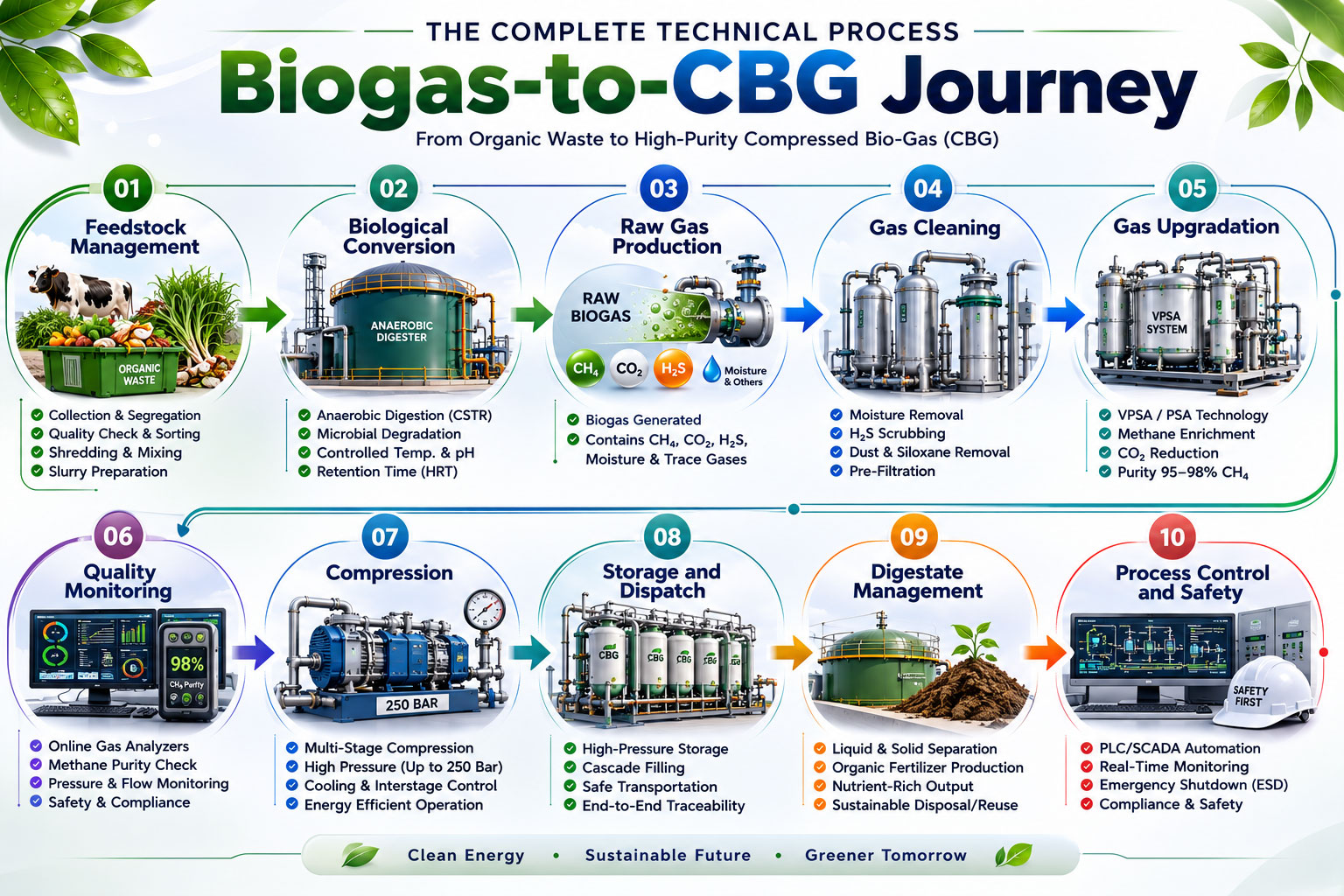
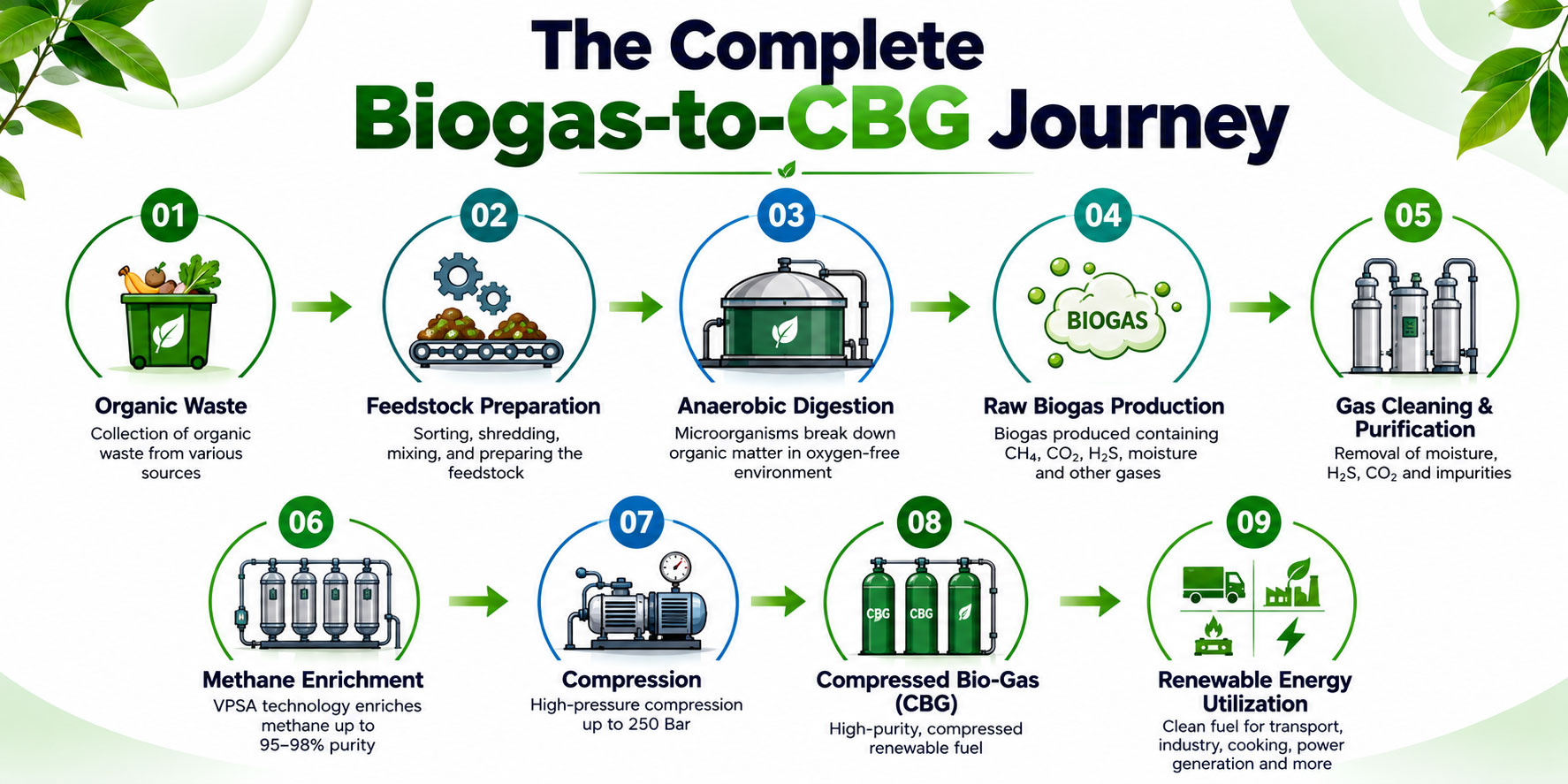
Organic Feedstock → Anaerobic Digestion → Raw Biogas → Gas Cleaning → Biogas Upgradation → Compression → CBG
However, this apparently simple process flow involves several interconnected engineering systems. Producing CBG consistently requires more than installing a purification unit after a digester. The raw biogas production rate, gas composition, contaminant levels, purification technology, methane recovery, compression system, instrumentation, safety systems, and plant operating philosophy must function as an integrated process.
Biogas and CBG originate from the same biological process, but they represent different stages of gas processing and utilization.
Raw biogas is the direct gaseous product of anaerobic digestion. CBG is the final methane-rich gaseous fuel obtained after suitable treatment, upgrading, and compression of biogas.
The fundamental difference can be summarized as:
Raw biogas is a biological product. CBG is an engineered fuel produced by processing that biological product.
A simplified comparison is shown below:
| Parameter | Raw Biogas | Compressed Bio-Gas (CBG) |
|---|---|---|
| Source | Directly produced through digestion | Produced from cleaned and upgraded biogas |
| Methane Concentration | Variable and feedstock-dependent | Increased through gas upgrading |
| Carbon Dioxide | Present in significant quantities | Substantially reduced |
| Hydrogen Sulfide | May be present at varying concentrations | Reduced according to product and process requirements |
| Moisture | Generally high | Reduced through gas treatment |
| Compression | May be used at low process pressure | Compressed for storage, transport, or utilization |
| Energy Density | Lower per unit volume | Higher due to methane enrichment |
| Primary Application | Thermal energy, boilers, CHP, or further processing | Commercial renewable gaseous fuel |
This distinction is important because the technical requirements of a biogas plant and a CBG plant are not identical.
A biogas plant may be designed primarily to produce and utilize raw gas.
A CBG plant must additionally incorporate systems for gas cleaning, upgrading, quality monitoring, compression, storage or dispatch, safety, and regulatory compliance.
The conversion of raw biogas into CBG generally involves several major stages. The exact configuration varies according to the feedstock, raw gas composition, plant capacity, purification technology, final product requirements, and project economics.
A typical process may include:
Raw Biogas Collection
↓
Hydrogen Sulfide Reduction
↓
Moisture Management
↓
Gas Conditioning
↓
Carbon Dioxide Separation
↓
Methane Enrichment
↓
Product Gas Quality Monitoring
↓
Gas Compression
↓
Storage / Transportation / Utilization
Each stage performs a specific function, and the performance of one system can directly influence the next.
The first step after biogas production is the controlled collection and transfer of raw gas from the digester or gas holder to the downstream treatment system.
This stage may involve:
The raw gas supply to the purification system should be maintained within the operating conditions required by the selected technology. Significant fluctuations in gas flow, pressure, or composition can affect downstream purification performance. Therefore, gas production and gas treatment should not be designed as completely independent systems. The biological plant and the gas processing plant must operate as an integrated facility.
Hydrogen sulfide is one of the most important contaminants that may need to be reduced before downstream processing.
H2S can create problems because it is:
Depending on the inlet concentration and required outlet specification, H2S treatment may be carried out using technologies such as: Biological desulfurization, Iron-based media, Activated carbon, Chemical absorption, and Other suitable treatment systems.
In some plant configurations, H2S reduction may occur in multiple stages. For example: Bulk H2S Removal → Fine H2S Polishing.
The appropriate system should be selected based on actual raw gas conditions rather than assumptions. Important design parameters include: Inlet H2S concentration, Gas flow rate, Required outlet concentration, Operating temperature, Moisture conditions, Media consumption, Regeneration requirements, and Operating cost.
Raw biogas typically contains significant moisture. Before entering sensitive purification and compression equipment, the gas may require cooling, condensate removal, and drying.
Depending on the process design, the gas conditioning system may include: Gas coolers, Chillers, Condensate separators, Knockout drums, Moisture traps, Drying systems, and Filtration equipment.
Effective moisture management is essential because uncontrolled condensation can lead to: Corrosion, Pipeline blockage, Instrumentation problems, Damage to purification equipment, and Compressor reliability issues. Gas conditioning is therefore a critical part of the overall CBG production process.
The principal objective of biogas upgrading is to separate a significant portion of the carbon dioxide and increase the methane concentration of the product gas.
Several technologies are available for this purpose. These may include: Pressure Swing Adsorption (PSA), Vacuum Pressure Swing Adsorption (VPSA), Membrane Separation, Water Scrubbing, Chemical Scrubbing, and Other suitable upgrading processes.
No single purification technology is automatically the best choice for every CBG project. The selection should consider: Raw biogas flow, Methane concentration, CO2 concentration, H2S concentration, Moisture content, Product gas specification, Methane recovery, Energy consumption, Operating pressure, Plant operating hours, Automation requirements, Maintenance requirements, Capital cost, and Operating cost.
The correct question is therefore not: “Which purification technology is the best?” The technically appropriate question is: “Which purification technology is most suitable for this specific plant, feedstock, gas composition, operating profile, and commercial requirement?” That distinction matters enormously in real-world CBG project design.
A purification system should not be evaluated only by the methane percentage achieved in the product gas. Another critical parameter is: Methane Recovery. Methane recovery represents the proportion of methane entering the purification system that is retained in the product gas. Some methane may be lost in: Off-gas, Vent streams, Regeneration streams, and Process losses.
Consider a simplified example.
If an engineer evaluates only final methane purity, System A may initially appear superior. However, System B may recover substantially more of the methane originally present in the raw gas. This can significantly influence: Daily CBG production, Revenue, Energy efficiency, Greenhouse gas performance, and Overall project economics.
Therefore: High methane purity without high methane recovery does not necessarily represent an efficient CBG purification system. Both parameters must be evaluated together.
Before compression and dispatch, the upgraded gas should be monitored to ensure that it meets the required product and process specifications. Depending on the plant configuration and applicable requirements, important parameters may include: Methane concentration, Carbon dioxide, Hydrogen sulfide, Moisture, Oxygen, and Other relevant gas-quality parameters.
Monitoring may involve: Online gas analyzers, Flow meters, Pressure transmitters, Temperature transmitters, Dew-point monitoring, Laboratory testing, and SCADA-based data logging. Continuous or periodic gas-quality monitoring helps ensure stable operation and allows plant operators to identify changes in purification performance.
After purification, the upgraded methane-rich gas is compressed according to the requirements of storage, transportation, or final utilization. Compression is one of the most important mechanical operations in a CBG plant.
The compressor system should be selected based on parameters such as: Inlet gas flow, Inlet pressure, Required discharge pressure, Gas composition, Operating hours, Number of compression stages, Cooling requirements, Lubrication philosophy, Capacity control, and Safety requirements.
The compressor should not simply be selected according to the plant’s daily CBG production target. The hourly operating profile is equally important.
For example, a plant producing 5,000 kg of CBG per day could theoretically operate its compression system: Continuously over 24 hours, Over 16 hours, Over 10 hours, or Over 6-8 hours. Each operating philosophy would require a different hourly compressor capacity.
This leads to an important engineering principle: Daily plant capacity and hourly equipment capacity are not the same thing. Ignoring this distinction can result in oversized or undersized equipment.
After compression, CBG can be handled according to the commercial and logistical requirements of the project.
Depending on the project configuration, this may involve:
The appropriate configuration depends on:
Therefore, the gas utilization strategy should ideally be considered during the early project design stage rather than after the plant has been constructed.
A common mistake in project planning is to divide the plant into isolated equipment packages:
Digester + Purification Unit + Compressor = CBG Plant
In reality, a successful CBG facility is much more complex.
The complete system includes:
Each system which influences the overall plant performance.
For example:
Unstable Feedstock → Biological Instability → Variable Raw Gas Production → Fluctuating Purification Load → Unstable Compressor Operation → Reduced Plant Performance
This demonstrates why integrated engineering is essential.
A successful CBG plant is not created by connecting a digester to a purification unit and compressor. It is created by engineering the entire biological, mechanical, electrical, instrumentation, safety, and operational process as one integrated system.
The next section should be “Biogas vs CBG: Understanding the Technical and Commercial Differences”. We touched on the comparison here, but the next part can go deeper into energy value, applications, treatment requirements, compression, storage, economics, and commercial utilization without turning the blog into a brochure wearing a lab coat.
No.
A properly designed CBG project involves multiple disciplines working together. These include: Microbiology, Biochemistry, Mechanical engineering, Civil engineering, Electrical engineering, Instrumentation and automation, Gas purification, Gas compression, Feedstock management, Digestate management, Safety engineering, Environmental compliance, and Plant operation and maintenance.
This is why simply installing a digester, purification unit, and compressor does not automatically guarantee successful CBG production. The entire process must be designed as an integrated system.
Several factors influence the performance of an anaerobic digestion system.
Important parameters include:
A successful biogas plant requires continuous monitoring and understanding of these interconnected parameters.
This is exactly why we created the Sonali Bio Gas Daily Knowledge Series: to explain the science, engineering, operation, and practical realities of biogas and CBG plants one topic at a time.
At the same time:
Anaerobic Digestion → Digestate → Appropriate Processing → Potential Organic Fertilizer Utilization
This is the foundation of the waste-to-energy concept.
Biogas and CBG technologies offer an opportunity to transform biodegradable organic resources into renewable energy. However, successful CBG production depends on much more than gas generation. It requires a scientific understanding of feedstock, microbiology, process parameters, digester design, gas purification, compression, safety, and plant operation.
The first principle to remember is:
Biogas is produced by biology. CBG is produced by combining biology with engineering and process control.
Understanding this difference is the first step toward understanding how a modern CBG plant actually works.
Understanding the Anaerobic Digestion Process: From Organic Matter to Methane